
Eye Drop Packaging: History, Design, and Machinery
Eye drops look simple. A small bottle, a narrow tip, a twist cap. Yet behind that simplicity sits one of the most demanding packaging challenges in the entire pharmaceutical industry. The eye is one of the most sensitive and unforgiving organs in the human body. Any product that touches it must clear a much higher bar than almost any other drug delivery format. That bar starts with the packaging.
At HMPL Sterile, we design and manufacture eye and ear drop filling, plugging, capping, labelling, and cartoning machinery for pharmaceutical companies worldwide. We spend our working days thinking about bottlenecks, torque specifications, dropper tip apertures, and sterility assurance. We know that a packaging line is not just equipment on a factory floor. It is the last line of defence between a formulation and a patient’s eye.
This guide walks through five areas: what eye drops are, how eye drop packaging has evolved, what goes into designing a safe and functional bottle, why packaging matters so much in this category, and how a complete packaging line brings all of it together.
What Are Eye Drops, and How Do People Use Them?
Eye drops, known formally as ophthalmic solutions, are liquid medications that patients apply directly to the eye. They treat a wide range of conditions and needs, and manufacturers generally group them into a few broad categories.
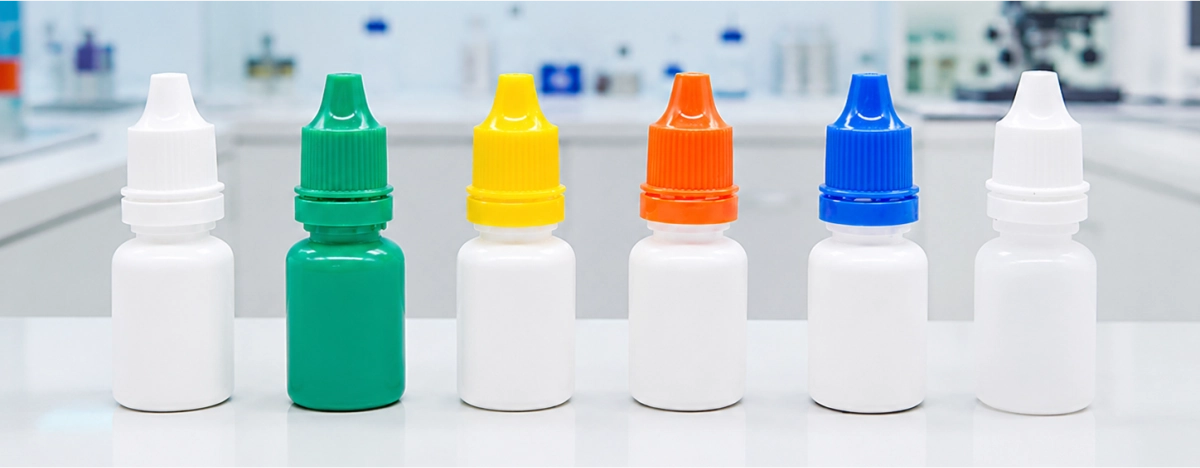
- Lubricating drops (artificial tears) relieve dryness, irritation, and the gritty discomfort that comes from reduced tear production. Retailers sell these widely over the counter. Millions of people who spend long hours in front of screens or live in dry climates use them.
- Antibiotic and anti-infective drops treat bacterial infections such as conjunctivitis. These require a prescription and demand strict sterility. Any contamination the patient introduces during use can worsen the very infection the drug is meant to treat.
- Anti-allergy and antihistamine drops reduce the itching, redness, and watering associated with seasonal or chronic allergic conjunctivitis.
- Anti-glaucoma drops lower intraocular pressure, and patients managing glaucoma often use them daily, sometimes for life. Because these products serve a chronic need among an ageing patient population, ease of use and dosing accuracy carry extra weight.
- Steroid and anti-inflammatory drops manage post-surgical inflammation, uveitis, and other inflammatory eye conditions, typically under close medical supervision.
- Diagnostic drops, such as mydriatics that dilate the pupil, appear in clinical settings. Doctors use them before an eye examination rather than at home.
Each of these categories comes with its own packaging demands. A preservative-free lubricant meant for frequent daily use calls for a different container strategy. A glaucoma medication meant to last thirty days after opening needs a different approach entirely. This is exactly why manufacturers cannot treat eye drop packaging as one-size-fits-all. It is also why they work closely with packaging engineers from the earliest stages of formulation.
Eye Drop Packaging in the Market: From History to Latest Trends
Eye drop packaging has changed dramatically over the past century. Each shift has pursued the same underlying goal: reducing risk to the eye while making the product easier and safer to use.
The Early Days: Glass Bottles and Rubber Droppers
Manufacturers commonly dispensed early ophthalmic preparations in glass bottles with separate rubber-bulb droppers, a format older generations of patients still remember. Glass offered excellent chemical inertness and clarity, but it was fragile and heavier to transport. The separate dropper also introduced extra handling steps that raised contamination risk every time it touched a surface or the eye itself.
The Shift to Plastic Squeeze Bottles
The mid-to-late twentieth century brought a shift to plastic. Manufacturers began using low-density polyethylene (LDPE) squeeze bottles with an integrated dropper tip molded directly into the bottle. This single change solved several problems at once. It removed the loose rubber bulb and reduced breakage during shipping and handling. It also cut manufacturing costs and let the bottle itself control drop size through the design of the tip orifice.
Advances in Closure Systems
From there, packaging engineers turned their attention to the closure system. Tamper-evident bands, induction seals, and integrated piercing pins became standard. Regulators pushed for stronger proof that no one had opened or adulterated a product before it reached the patient. Multi-piece dropper assemblies typically a bottle, a separate dropper tip insert, and a screw cap became the dominant format. They let manufacturers fine-tune drop volume independently of the bottle body.
Solving the Preservative Problem
The most recent wave of innovation addresses a different problem entirely: preservatives. Many multi-dose eye drops rely on preservatives such as benzalkonium chloride to prevent microbial growth once patients open the bottle and expose it to repeated air and finger contact. Preservatives, however, can irritate sensitive eyes with long-term use.
This has pushed the market toward preservative-free multi-dose systems. These systems use one-way valves, filtering membranes, or airless pump mechanisms to keep the internal contents of the bottle sterile without any added preservative. These systems cost more to manufacture but answer a genuine clinical need, particularly for patients using glaucoma medication daily for years.
Sustainability in Modern Packaging Design
Alongside these functional changes, sustainability has entered the conversation. Manufacturers are increasingly evaluating recyclable resins and lighter-weight bottle designs that use less plastic without compromising squeezability. They are also investing in packaging lines flexible enough to switch between multiple bottle formats without long changeover times.
Ophthalmic Eye Drop Bottle: Parts, Packaging, and Materials
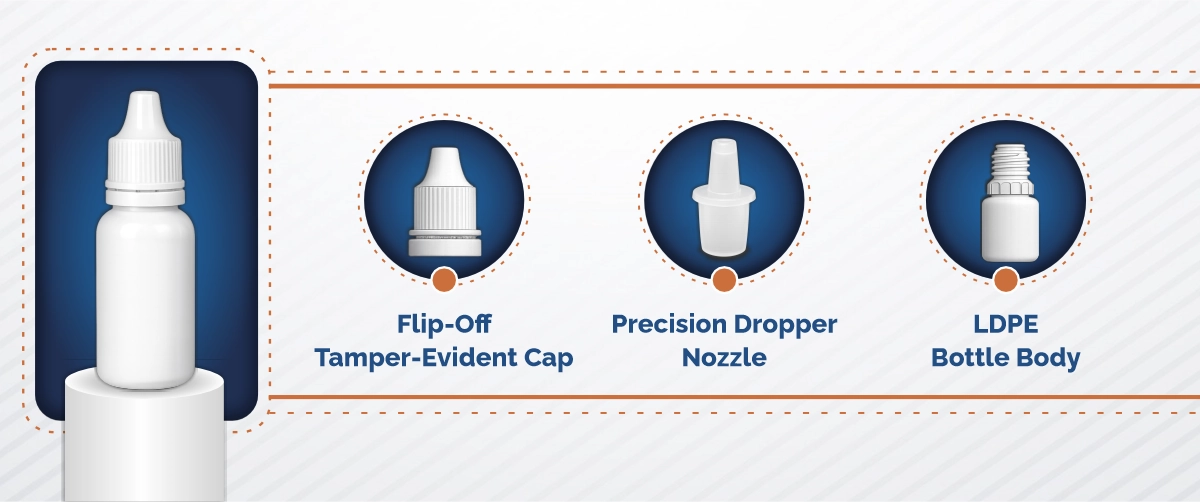
An eye drop bottle looks like one part, but it is really a small assembly of components, each engineered to a specific tolerance.
The Bottle Body
Manufacturers almost always make the bottle body from LDPE or a blend of LDPE and other polyolefins. They choose this material for several reasons. It is chemically compatible with most ophthalmic formulations and does not leach compounds into the liquid. It is also soft enough to squeeze evenly with light finger pressure, and transparent or translucent enough to allow a visual fill-level check.
The Dropper Tip
The dropper tip or orifice insert controls drop size and drop consistency, arguably the single most safety-critical dimension in the entire package. A tip that is even slightly too large delivers an oversized drop and wastes product. It can also shorten the number of usable days a patient gets from a bottle meant to last a set treatment period. A tip that is too small may frustrate dosing or clog. Engineers measure precision here in fractions of a millimeter.
The Plug or Insert
The plug or insert sits inside the neck of the bottle. It is often the piece responsible for maintaining a seal between doses while still allowing controlled dispensing when the bottle is squeezed. In many designs, this plug also houses a filter or valve system for preservative-free formulations.
The Cap
The cap provides the final barrier against contamination and environmental exposure. Cap torque is a deceptively important specification. If the cap is too tight, older adults or patients with limited hand strength or dexterity cannot open the bottle without help. If it is too loose, the seal may not hold, or the tamper-evident feature may break prematurely during shipping.
The Tamper-Evident Band or Seal
The tamper-evident band or seal proves to the patient that no one has opened the product before first use. Manufacturers industry-wide have documented this as a source of design problems. Loose or non-retaining tamper-evident rings can slip down the bottle neck. In rare but serious cases reported to regulators, they fall directly onto a patient’s eye during use, sometimes leaving sharp plastic edges that scratch the cornea. This shows how a seemingly minor packaging component can become a genuine safety issue if the engineering is not right.
Secondary Packaging
Secondary packaging, typically a printed carton with a folded package insert, protects the bottle physically and shields light-sensitive formulations from degradation. It also carries the labelling and dosing instructions patients rely on.
Material Selection and Compatibility Testing
Compatibility testing governs material selection throughout all of these components. Packaging engineers test for extractables and leachables, moisture and oxygen barrier performance, and resistance to the specific pH and preservative system of the formulation inside. A bottle resin that works perfectly for one drug can be entirely wrong for another. This is why manufacturers qualify materials on a product-by-product basis rather than once for an entire product line.
Why Eye Drop Bottle Packaging Matters So Much in Pharma?
It is worth pausing on why this category of packaging carries so much weight, because the reasons are not obvious until you look closely.
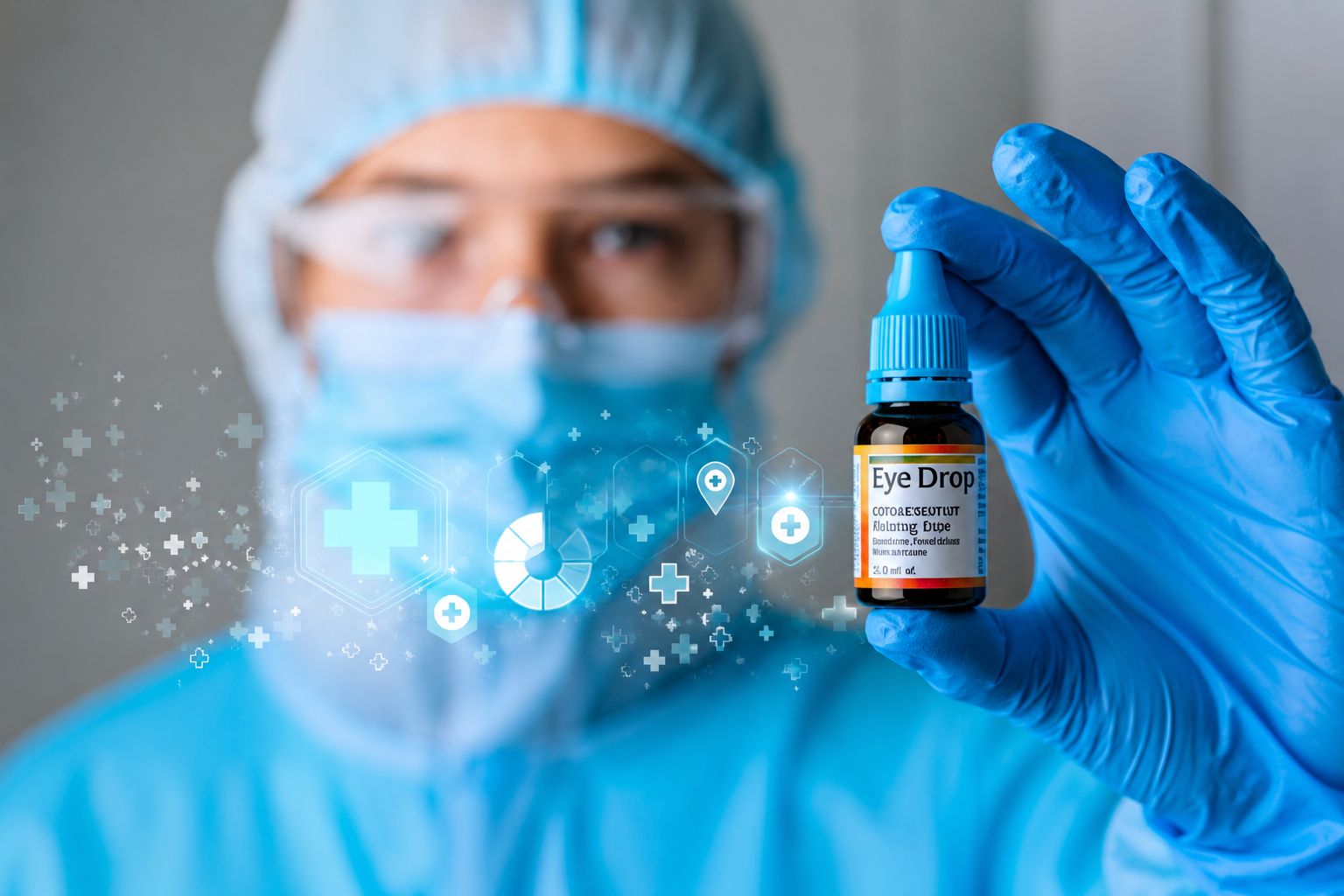
The Eye Has Almost No Natural Defence Against Contamination
Unlike the digestive system or skin, the eye has very limited natural barriers against introduced microbes. Regulators require any drug applied to the eye to be sterile. That sterility has to survive not just manufacturing and shipping but weeks of repeated patient use, opening, closing, and occasional accidental contact between the dropper tip and fingers, eyelashes, or surfaces. The packaging is what stands between a sterile fill and a contaminated bottle three weeks into use.
Recalls in This Category Are Frequent and Severe
Regulatory bodies have issued multiple safety alerts and nationwide recalls in recent years tied directly to contamination risk in eye drop products. Consequences have ranged from eye infections to permanent vision loss. These recalls almost always trace back to either manufacturing sterility failures or packaging design flaws. Common flaws include inadequate seals, closures that invite contamination, or dispensing mechanisms that fail to control drop volume.
Dosing Accuracy Depends Entirely on the Bottle, Not the Formulation
A well-formulated drug delivered through a poorly designed dropper tip can still under-treat or over-treat a patient. Regulatory reviewers pay close attention to drop volume consistency. This matters especially when they compare a generic product’s packaging performance against the reference product it is meant to match. A meaningfully larger or smaller drop size changes how long a bottle lasts and how much drug actually reaches the eye.
Patient Usability Is a Genuine Safety Factor, Not a Convenience Issue
Many chronic eye conditions, glaucoma in particular, disproportionately affect older patients, some of whom have reduced hand strength or dexterity. A cap that requires excessive torque to open, or a multi-step piercing procedure that confuses the user, can push some patients toward using household tools like scissors to open a dropper tip. This introduces an entirely avoidable injury risk. Packaging that a healthy twenty-five-year-old finds effortless may be genuinely difficult for the patient actually using the product.
Packaging Protects the Drug From Itself, and From the Environment
Many ophthalmic actives are light-sensitive or oxygen-sensitive. Amber or opaque bottles and cartons, combined with tight closure systems, extend shelf life and preserve potency for the full labelled duration of use.
A Distinct and Heavily Scrutinized Category
Put together, these factors explain why regulators treat ophthalmic container closure systems as a distinct and heavily scrutinized category, separate from general pharmaceutical packaging rules. For manufacturers, that means the packaging line producing these bottles has to run with pharmaceutical-grade precision on every single unit, not just on average.
Eye Drop Bottle Packaging Machinery: Primary to Secondary
A finished, sealed carton of eye drops on a pharmacy shelf is the result of a sequence of machines. Each machine handles one precise step. At HMPL Sterile, we build and supply the individual machines and complete lines that carry a bottle from raw component to shelf-ready product.
Unscrambler with Air Jet Cleaning Machine
Before a single drop of liquid touches a bottle, the bottle itself has to be clean and correctly oriented. An unscrambler receives bulk-loaded empty bottles, often eye-ear drop bottles, nasal spray bottles, or general PP bottles. It automatically orients every bottle upright and in the correct position for the line ahead. Built-in high-pressure air jet cleaning stations blow out any dust, plastic shavings, or manufacturing debris trapped inside each bottle before it proceeds to filling. This step matters more than it might seem: any particulate left inside a bottle becomes a particulate the patient eventually applies to their eye.
Automatic 3-Piece Eye Drop Filling, Plugging and Capping Machine
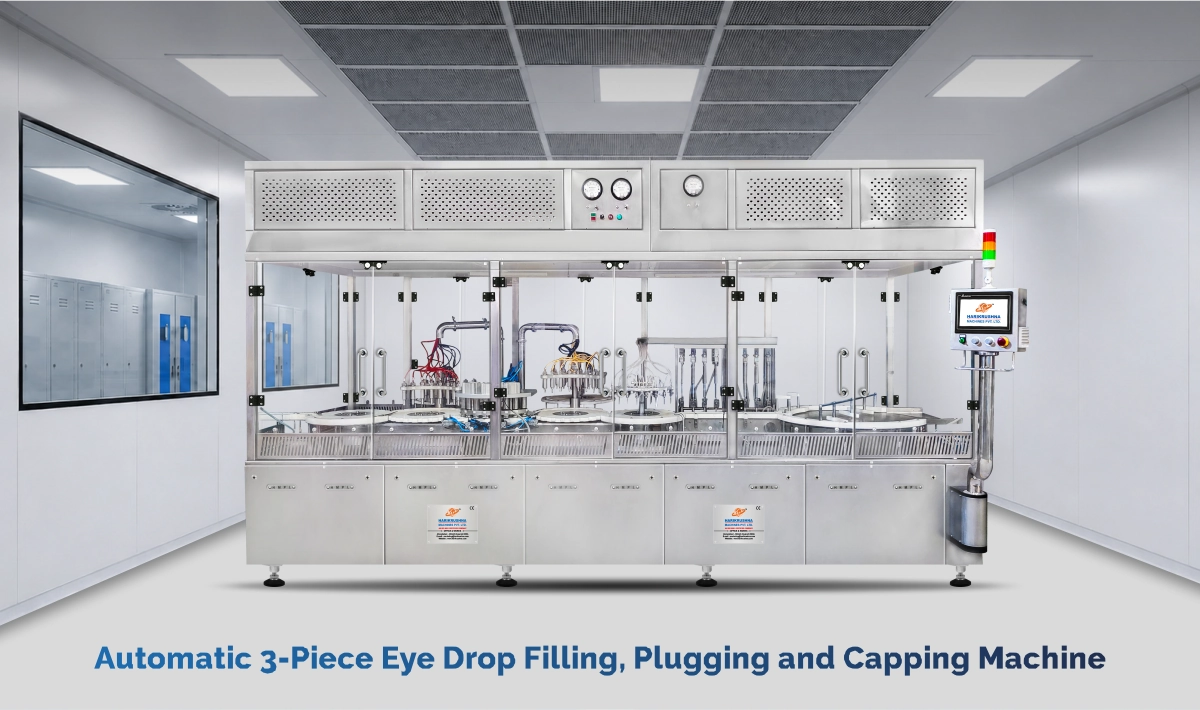
This is the heart of the primary packaging process. An Automatic 3-Piece Eye Drop Filling, Plugging and Capping Machine performs the sequence that turns an empty, clean bottle into a sealed, dosed product. This includes precise liquid filling to the correct volume, insertion of the plug or dropper-tip insert, and application and torquing of the cap, all in a single continuous, automated flow. Eye and ear drop formulations are typically low-viscosity, free-flowing liquids filled in small volumes, so filling accuracy at this stage has to be tight. The machine’s plugging and capping stations also have to apply consistent, repeatable force. This ensures every bottle leaving the line has the same seal integrity and the same cap torque.
Automatic High-Speed Rotary Sticker Labelling Machine
Once manufacturers fill and seal a bottle, it needs a label carrying the product name, batch number, expiry date, and regulatory information. A rotary sticker labelling machine applies labels at high speed and with tight positional accuracy across a wide range of bottle diameters. This matters because eye-ear drop bottles and vials vary considerably in size from one product line to the next. Output speeds in the range of hundreds of bottles per minute allow this station to keep pace with upstream filling without becoming a bottleneck.
Automatic Shrink Sleeve Applicator Machine
Some products need a full-body sleeve label, tamper-evident neck banding, or brand graphics wrapped around an irregular bottle shape. For these, a shrink sleeve applicator machine feeds a pre-cut sleeve over the bottle, then passes it through a heat tunnel that shrinks the sleeve tightly onto the container’s contours. This equipment typically includes a rotary cutter to size each sleeve and a cooling fan after the shrink tunnel to set the sleeve in place. It also includes safety guarding around the moving components. Manufacturers use this step wherever tamper evidence or shelf branding needs to sit directly on the bottle rather than relying on the cap alone.
Automatic Eye-Ear Drop Bottle Cartoning Machine
At this stage, filled and labelled bottles move from primary to secondary packaging. A cartoning machine checks that each incoming product is present and correctly filled. It embosses or prints batch codes onto the carton, erects a flat carton blank into its final box shape, inserts the folded package leaflet alongside the bottle, closes the carton, and discharges the finished pack. Continuous-motion cartoning machines in this category can run anywhere from around 120 to 240 cartons per minute. Manufacturers typically configure them to handle a defined range of carton lengths, depending on whether the line uses a two-chain, three-chain, or four-chain configuration.
Packing Conveyor
Every stage above needs to hand product to the next stage smoothly, and that is the job of the packing conveyor. It moves bottles and cartons between machines on a continuously running belt. This keeps the line synchronized so that no station starves for input or backs up with excess output. In a well-designed line, engineers size and speed-match conveyors precisely to the throughput of the filling, labelling, and cartoning stations they connect.
BOPP Tape Sealing Machine
At the very end of the secondary packaging process, outer shipping cartons need to be closed and sealed for transport. A BOPP tape sealing machine automates this step. It applies tape across the top and bottom flaps of each shipping carton with consistent pressure and placement, protecting the sealed integrity of the shipment and giving it a clean, professional finish before it leaves the facility.
Complete Eye-Ear Drop Packaging Line
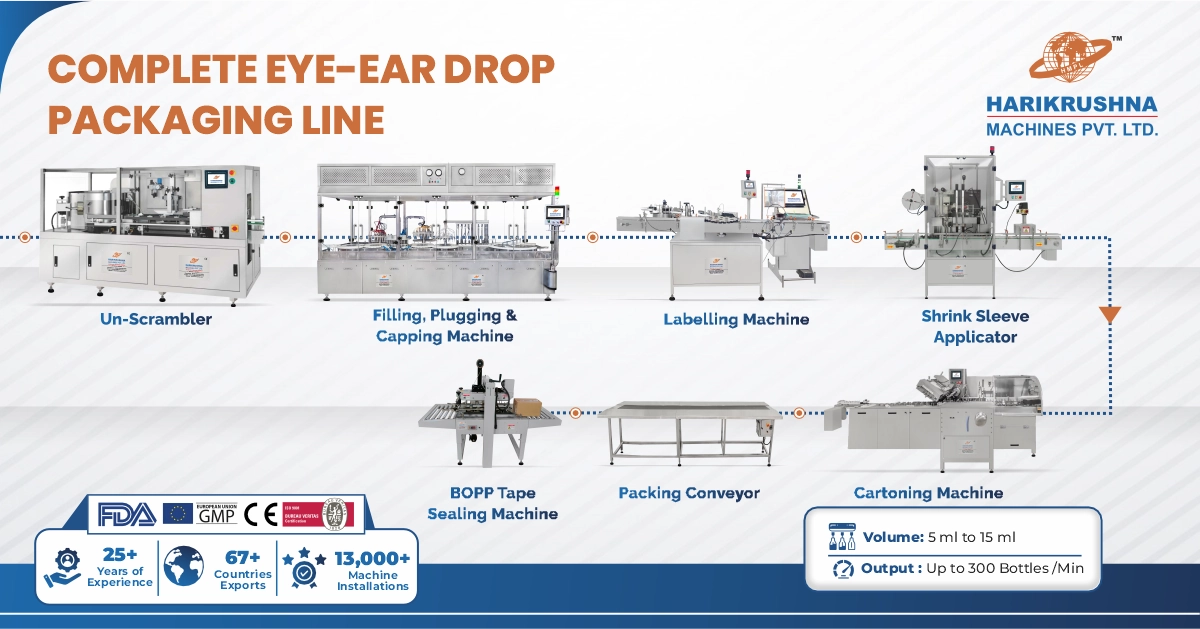
Individually, each of the machines above solves one problem. Connected, they form a complete eye-ear drop packaging line. This line takes empty bottles in at one end and delivers sealed, labelled, cartoned, and shipment-ready product out the other, with minimal manual intervention in between.
HMPL Sterile builds its complete eye-ear drop packaging line for free-flow liquid fills from 5 ml to 15 ml, running at speeds up to 200 bottles per minute. A few characteristics define what makes a line like this work well in a real pharmaceutical production environment:
- Accurate filling: Volume consistency across every single bottle on the line is non-negotiable in ophthalmic production, where drop size directly affects dosing and treatment duration.
- Aseptic packaging and compliance: Engineers design the line around the sterility requirements that regulators apply specifically to ophthalmic products, from bottle cleaning through final sealing.
- Versatility: Pharmaceutical manufacturers rarely run just one SKU. A line that can switch between different bottle sizes, cap types, and carton formats without excessive downtime keeps a facility flexible as product portfolios grow.
- High speed and efficiency: Throughput has to scale with commercial demand without sacrificing the accuracy that regulators and patients depend on.
- Customization: No two manufacturers run identical processes. A packaging line worth investing in should adapt to the specific bottle geometry, closure system, and carton design. It should match what a manufacturer has already validated for their product.
The Importance of International Standards for Eye-Ear Drops Worldwide
Because ophthalmic products carry heightened patient risk, regulators subject them to close and specific attention nearly everywhere they are sold. National health authorities require manufacturers producing eye drops for markets like the United States to register their facilities. These authorities also actively monitor products already on shelves through sampling, testing, and adverse event tracking, not just at the point of initial approval.
Regulators review container closure systems for ophthalmic products as part of the drug approval process itself. They do not treat these systems as an afterthought to the formulation. Regulators expect manufacturers to qualify packaging components such as tamper-evident collars, speciality seals, and dropper-tip assemblies. Manufacturers must also demonstrate that these components perform their intended function reliably before a product reaches the market. Where a company changes a packaging component after approval, that change typically requires its own supporting data and, in many cases, regulatory notification or approval.
Good manufacturing practice (GMP) requirements extend across the entire packaging line, not just the filling station. That means equipment cleanliness, material traceability, batch coding accuracy, and validated process parameters for filling, plugging, capping, and sealing all fall within scope for regulatory inspection. This is precisely why packaging line design cannot be an isolated engineering decision. Manufacturers have to build compliance in from the first machine to the last.
For manufacturers exporting across multiple markets, packaging that satisfies one regulator’s expectations does not automatically satisfy another’s. Building a packaging line with the flexibility to meet varying international standards, while maintaining consistent core quality controls, gives manufacturers room to grow into new markets. They can do this without redesigning their production process each time.
Building the Right Packaging Line for Your Eye Drop Products
Eye drop packaging sits at the intersection of formulation science, mechanical precision, and patient safety in a way that few other pharmaceutical categories do. A bottle that looks identical to a competitor’s on a shelf can behave very differently once it reaches a patient’s hands. Those differences show up in dosing accuracy, contamination risk, shelf life, and patient trust.
At HMPL Sterile, we build unscramblers, filling-plugging-capping machines, labelling systems, shrink sleeve applicators, cartoning machines, conveyors, and tape sealing equipment. We offer these both as standalone units and as fully integrated eye-ear drop packaging lines, engineered around the accuracy and compliance this category demands.
If your team is evaluating new packaging equipment, upgrading an existing line, or planning a facility built around ophthalmic production, we would welcome the conversation. Let’s talk about what that line should look like for your specific product.
About Harikrushna Machines Pvt. Ltd.
Harikrushna Machines Pvt. Ltd. (HMPL) is an ISO 9001:2015 and CE-certified company with over 25 years of expertise as a leading Original Equipment Manufacturer (OEM) for pharmaceutical processing and packaging solutions. We design and manufacture Oral Liquid Manufacturing Plants, Complete Packaging Lines, Standalone Machines, and Packaging Ancillary Equipment, delivering reliable, high-performance solutions tailored to the pharmaceutical industry.
With 13,000+ successful machine installations across 67+ countries, HMPL has earned the trust of pharmaceutical manufacturers worldwide. Our USFDA and EU GMP-compliant machines combine precision engineering, advanced automation, and regulatory compliance to help customers achieve efficient, reliable, and world-class pharmaceutical manufacturing.
About HMPL Sterile
HMPL Sterile is the specialized division of Harikrushna Machines Pvt. Ltd., dedicated to manufacturing advanced aseptic packaging machinery in the pharmaceutical industry. We engineer high-performance equipment that delivers precision, reliability, and compliance with global regulatory standards. By combining innovation with robust engineering, we help pharmaceutical manufacturers achieve efficient, safe, and consistent aseptic packaging operations.