A unidose nasal spray looks simple: a small device, one press, a fine mist. Behind it lies demanding pharmaceutical packaging: filling a precise amount of sterile liquid, sealing it, inspecting it, and assembling a working device without contamination, off-spec doses, or loose components. That is the job of our Fully Automatic Robotic Uni-Dose Nasal Spray Filling, Stoppering & Assembly Machine, the second robotic sterile filling system HMPL Sterile has built. In this Uni-Dose Nasal Spray Packaging Guide, we explain what a uni-dose nasal spray is, why the format is growing, how the machine handles each of its 13 stages, and what pharmaceutical teams should ask when evaluating any automated aseptic system. Uni-dose Nasal Spray Packaging Guide: Learn how a uni-dose nasal spray moves from an empty micro vial to a finished, ready-to-use dose.
Why Single-Dose Nasal Delivery Is Gaining Ground
The nasal route has obvious appeal. It is needle-free, quick, needs no water or swallowing, and the nasal mucosa offers a fast way into the body for the right molecules. That is why it is used for emergency rescue medicines, migraine therapy, paediatric sedation, allergy relief and a growing pipeline of nasal vaccines.
Within that route, the uni-dose format matters most where precision and hygiene matter most. A uni-dose device holds one pre-measured dose. It is used once and discarded. Compared with a multi-dose bottle that is opened, primed and reused over weeks, the single-use model offers clear advantages:
Uni-Dose Advantages: Lower Risk, Fewer Preservatives, Reliable Dosing
- Far lower in-use contamination risk. There is no repeated handling of one container, so nothing carries over from one use to the next.
- Often no need for preservatives. A product that is not meant to survive weeks of repeated opening can frequently be formulated without them, which matters for sensitive patients.
- Consistent dosing. No priming ritual, no guessing how many sprays are left, no variation from one actuation to the next.
- Simple use under pressure. In an emergency, a responder needs one device and one action.
Hospitals, emergency services and pharma brands are specifying the format more often for exactly these reasons. The catch is that the format shifts the burden onto manufacturing. When each unit is the entire dose, every unit has to be right.
The Microvial: The Small Container Everything Else Depends On
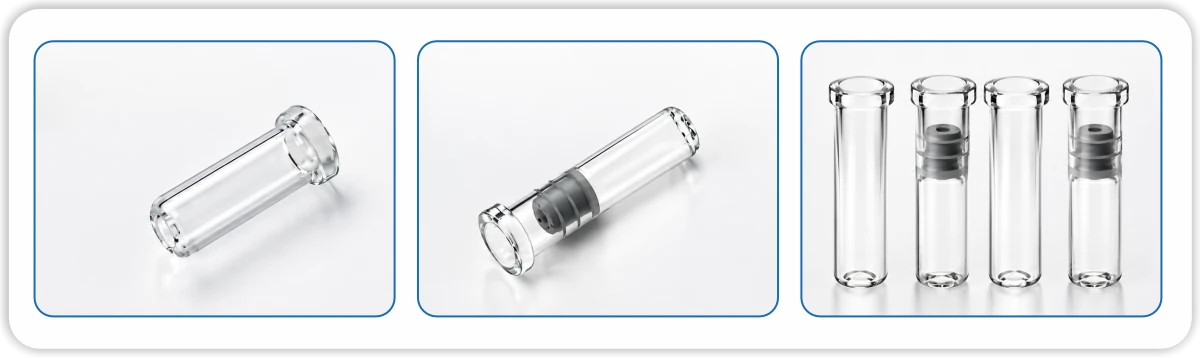
The microvial is the primary container of a uni-dose nasal spray. It is made from borosilicate glass tubing, with an extended flange at the top so it seats correctly inside the device and a tightly controlled inner diameter so the plunger can move smoothly. Because it is the part that touches the drug, its quality shapes drug stability, dosing consistency and device fit.
For an automated line, tight dimensional and cosmetic tolerances mean fewer rejections, less breakage and particle risk, and smoother handling. That is why the machine, the microvial and the delivery device should be qualified together as one system.
What Is Inside a Uni-Dose Nasal Spray Unit? and Importance of Uni-dose Nasal Spray Packaging
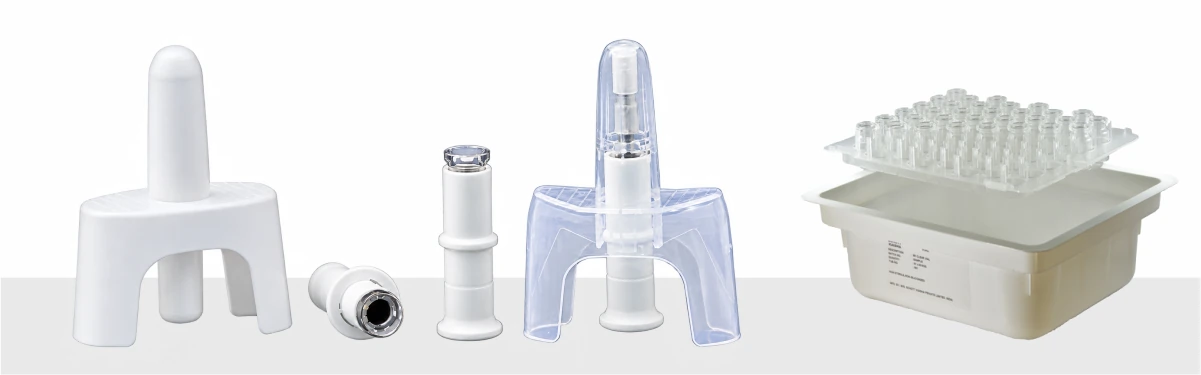
Designs vary between drug owners, but the machine we describe follows a common architecture: a small vial that holds the liquid, a rubber stopper that closes it, a holder that carries the vial, and a nasal adapter that turns the assembly into a sprayer. Our machine takes these components from loose parts to a locked, finished unit.
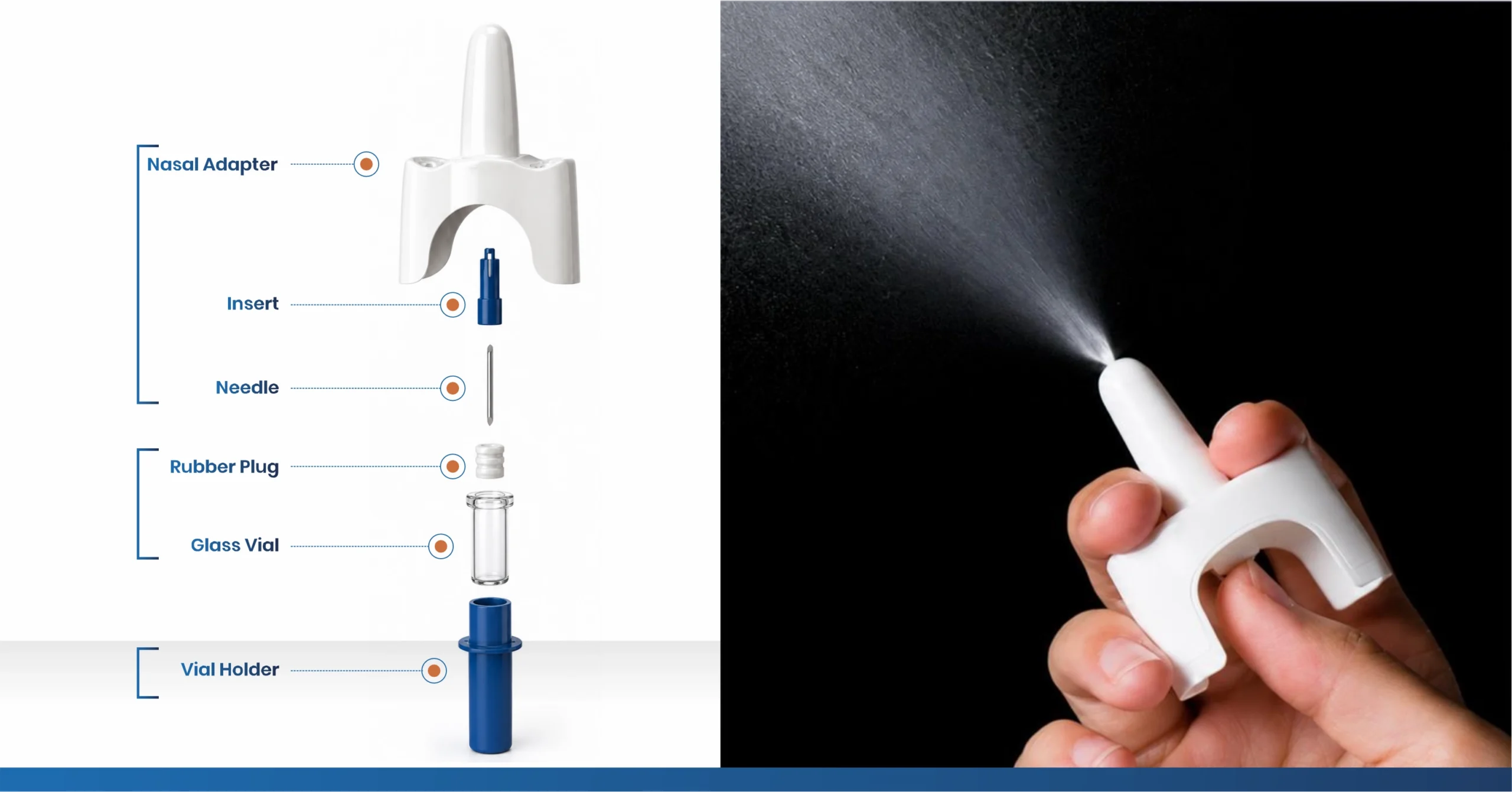
Two things make this assembly difficult. First, fill volumes are small, often a fraction of a millilitre, so a tiny absolute error becomes a large percentage error. Second, the product is sterile, so every point of contact between the liquid and the outside world has to be controlled. Doing the job by hand, or across a patchwork of semi-automatic stations, multiplies both risks.
Meet the Machine: Fully Automatic Robotic Uni-Dose Nasal Spray Filling, Stoppering & Assembly Machine
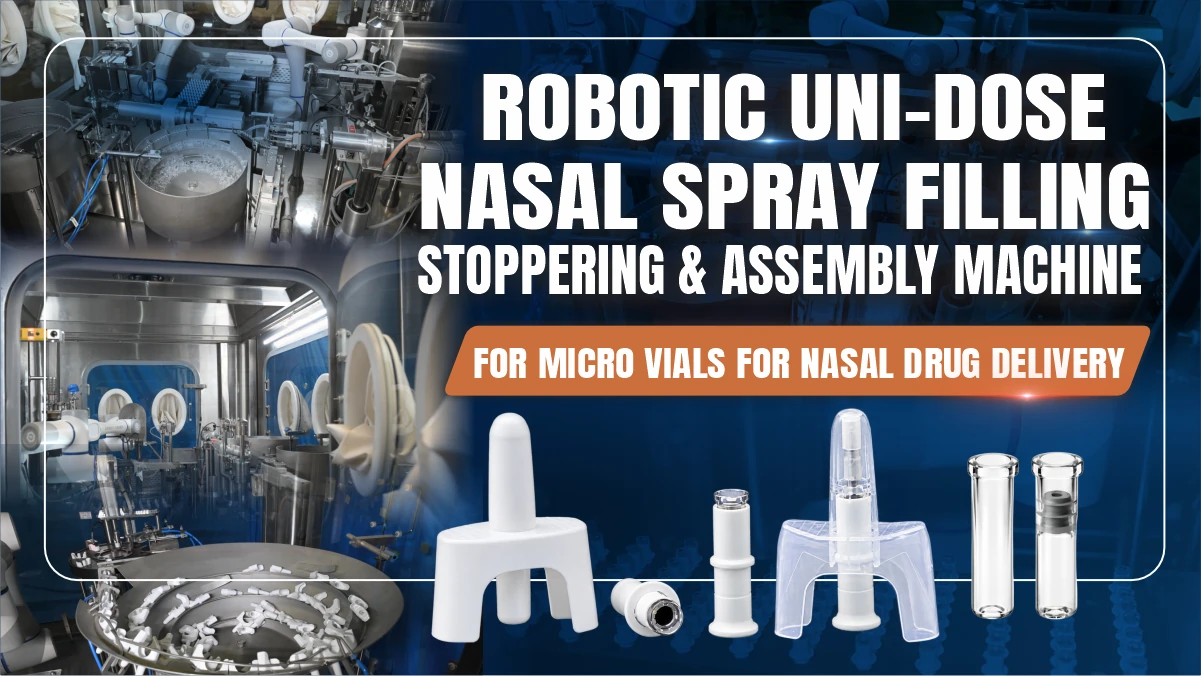
The machine is built around one idea: one continuous, in-line process from vial feeding to sorted collection of good and rejected units, with robotic arms handling the key operations and manual handling kept to a minimum.
- Output: up to 200 units per minute
- Process: 13 integrated stages, from vial feeding to good and reject collection
- Positioning: HMPL Sterile’s 2nd Robotic Sterile Filling System, designed for single-dose nasal spray production
Rather than treating filling, closing, inspection and assembly as separate jobs on separate machines, the system folds them into a single flow. For buyers, that means fewer transfers between stations, fewer places where a unit can be touched, dropped or mixed up, and one coordinated machine to validate and operate.
The 13 Stages, Explained: Robotic Uni-Dose Nasal Spray Filling, Stoppering & Assembly Machine
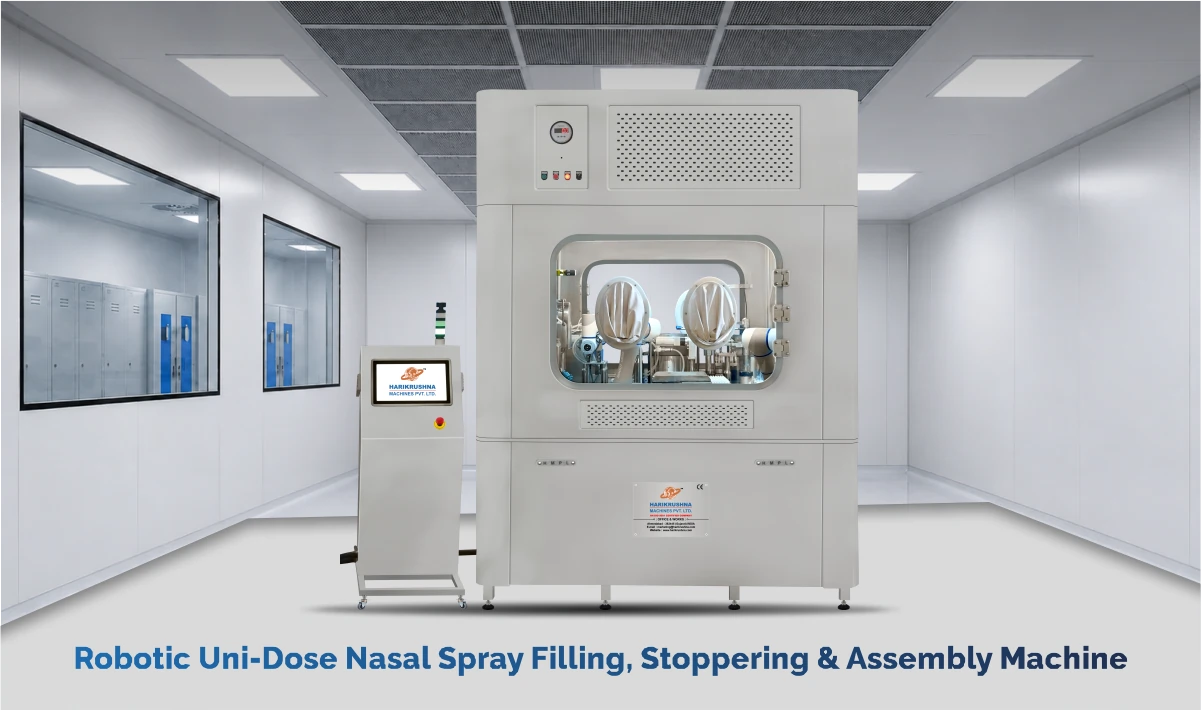
Preparing the vial (stages 1 and 2)
1. Vial feeding. Vials are loaded into the system automatically and presented in an orderly stream to the stations that follow. Automatic feeding removes one of the most common sources of operator touches at the very start of the machine.
2. Vial cleaning. Vials are cleaned before filling so that particles and debris do not enter the product. It is worth being precise here: cleaning prepares the vial for the fill, while the sterility of the container itself comes from upstream washing, sterilisation and depyrogenation.
Filling with 100% check-weighing (stage 3)
3. Liquid filling with 100% check-weighing. Each vial receives its dose, and every single filled unit is verified by weight. We come back to why this matters below.
Closing the vial (stages 4 and 5)
4. Rubber stopper feeding. Stoppers are fed into the machine automatically, ready for placement.
5. Vial stoppering. Stoppers are placed securely on the filled vials, closing the product inside its container before it moves on.
Inspecting and rejecting (stages 6 and 7)
6. Visual inspection. Every unit is inspected for defects.
7. Rejection of faulty units. Non-conforming vials are removed automatically, so a unit that fails inspection never travels forward into assembly.
Assembling the device (stages 8 to 12)
8. Vial placing in holder. Good vials are positioned into their holders.
9. Vial pressing in holder. Vials are pressed firmly into place so that they are seated correctly.
10. Adapter assembly. Nasal adapters are fitted onto the units.
11. Vial holder placement. Assembled units are placed in their final holders.
12. Holder locking. Holders are locked to secure the assembly.
Sorting the output (stage 13)
13. Good and reject collection. Finished units are sorted and collected separately, so conforming and non-conforming products never share a bin.
Notice the logic of the sequence. Inspection and rejection happen before the assembly steps. Components and effort are therefore never spent on a unit that has already failed, and the machine sends only good vials forward.
Why 100% Check-Weighing Changes the Quality Conversation
Traditional quality control in filling relies heavily on sampling: pull a few units at intervals, measure them, and infer the quality of everything in between. Sampling works when a process is stable, but it can only describe the units it actually measured.
100% check-weighing takes a different stance. Every unit is verified. Because each unit is a complete single dose, there is no “average” patient experience to hide behind. An underfilled vial is a patient who receives less medicine than intended; an overfilled one is a loss of expensive product and a departure from specification.
A few practical points are worth understanding:
- Weight is a proxy for volume. Check-weighing confirms that the fill mass sits within the defined tolerance. Because mass relates to volume through the liquid’s density, the tolerance is set per product and formulation.
- It gives trend data, not just pass or fail. A gradual drift in fill weights is an early signal that the filling system needs attention, long before units fall out of tolerance.
- It supports a confident batch story. When every unit has been weighed, release decisions and investigations rest on complete data rather than a sample.
The point is not that check-weighing replaces other controls. It is that it moves dose verification from “we believe” to “we measured” for each unit.
Why Robots, and Why Now?
The single largest contamination source in any aseptic process is people. Operators shed particles and microorganisms simply by being present, and every manual intervention adds risk. Regulators have been steadily pushing the industry in one direction: the revised EU GMP Annex 1 on sterile manufacturing places strong emphasis on a documented contamination control strategy and on minimising direct human intervention in critical operations.
Robotic handling answers that direction in a very practical way:
- Repeatability. A robotic arm performs the same motion, with the same positioning, the thousandth time as the first.
- Fewer interventions. With filling, stoppering and assembly handled by robotic arms, operators spend less time near critical areas.
- Consistency across shifts. Output quality does not depend on who is working or how long they have been on shift.
- Predictable, recordable motion. Automated sequences are easier to qualify, document and repeat than manual technique.
It is also fair to say what automation does not do. Sound cleanroom design, disciplined procedures, trained personnel, and proper validation all remain essential. Automation simply makes each of them easier to get right.
One Machine, Not Five Machines
Many unit-dose nasal spray projects begin with separate machines for filling, stoppering and assembly, connected by manual transfer or by trays. Each transfer is a risk: a touch, a delay, a mix-up between good and rejected units.
Integrating filling, stoppering, inspection, adapter fitting and holder locking into one machine addresses this directly:
- Less handling, less exposure. Units remain inside one controlled flow rather than moving between stations by hand.
- A cleaner reject strategy. The machine removes faulty units automatically and collects them separately from good output.
- Lower labour dependence. The machine needs fewer operators to feed, move, and assemble units.
- One system to qualify. A single integrated Machine is easier to document, validate and maintain than a chain of independent machines.
Uni-Dose Nasal Spray Packaging: Who Benefits Most?
Pharmaceutical manufacturers launching or scaling single-dose nasal products gain a validated, in-line way to produce consistent units without building an army of manual stations.
Contract development and manufacturing organisations serving multiple clients benefit from a machine that treats quality verification as a built-in step rather than an afterthought.
Emergency and hospital supply brands get the dose-to-dose consistency their end users rely on at the moments that matter most.
Companies planning a nasal vaccine or biologic programme can use a closed, minimally handled process to protect sterile integrity from the first vial to the last.
Questions to Ask When You Evaluate Any Robotic Uni-Dose Nasal Spray Filling, Stoppering & Assembly Machine
Whether you choose us or not, a few questions will sharpen your decision. We are glad to discuss each one for your specific project:
What environment does the machine operate in? Understand how you will integrate the machine into your cleanroom, isolator, or restricted-access barrier system (RABS), and how the design protects the filling zone.
What does the documentation package include? Ask about design documentation, qualification support (IQ, OQ and PQ) and data-integrity provisions that match your quality system.
How are formats changed over? If you run multiple fill volumes or component designs, change-part design and changeover time directly affect real-world productivity.
What are the product-contact materials? Compatibility with your formulation matters, particularly for sensitive biologics or aggressive solvents.
How is the stated speed achieved in practice? Nominal speed and validated, sustained speed on your product can differ. Ask for the basis of the figure on your own components and formulation.
What does the rest of the line look like? Washing, sterilization, labelling and cartoning decisions around the machine matter as much as the machine itself.
Our engineers can walk through these points based on your product, batch sizes and regulatory markets.
Frequently Asked Questions
What is a uni-dose nasal spray filling machine?
It is a pharmaceutical packaging system that fills, stoppers and assembles single-use nasal spray units, each delivering one pre-measured dose.
How does the machine support dosing accuracy?
The machine check-weighs every unit during liquid filling and verifies each vial against its weight tolerance before moving it on.
Is it suitable for aseptic production?
We design it for aseptic pharmaceutical production. Robotic handling and minimal manual contact help lower contamination risk across filling and assembly. We agree on the exact environmental configuration with you for each project.
What happens to defective units?
Every filled and stoppered vial passes automatic visual inspection. The machine rejects faulty units automatically and collects them separately from good ones.
What makes the system “robotic”?
Robotic arms handle key operations such as filling, stoppering and assembly, enabling automatic operation with minimal human intervention.
Conclusion
Uni-dose nasal sprays ask a lot of the machine that makes them: small, exact fills; sterile handling; zero tolerance for a faulty unit; and a finished device that works the first time. HMPL’s Fully Automatic Robotic Uni-Dose Nasal Spray Filling, Stoppering & Assembly Machine answers with a single robotic machine that fills, verifies, closes, inspects, rejects, assembles and sorts, one dose at a time and up to 200 units per minute.
If you are planning a single-dose nasal spray project, we would like to hear about it.
View the full machine specifications on our product page, and email marketing@harikrushna.com to speak with our team.