

Cooking oil packaging reveals far more than neatly arranged bottles on supermarket shelves as shoppers walk through today’s oil aisle. It tells the story of how modern consumers think, cook, and care for their health. As lifestyles become faster yet more health-focused, people now look beyond price and availability. They evaluate labels, compare fat profiles, and pay close attention to how oils are produced and packed. Edible oil packaging now plays a decisive role in this shift, driving innovation in presentation, protection, and transparency. What once felt like a basic grocery item has evolved into a carefully considered purchase shaped by nutrition science, sustainability, and consumer trust.
Premium and Mass-Market Trends in Modern Cooking Oil Packaging
The edible oil industry has responded with remarkable sophistication. Cold-pressed and speciality oils now arrive in premium glass bottles that signal purity, authenticity, and minimal processing, appealing to wellness-driven consumers. At the same time, everyday household and commercial needs rely on efficient vegetable oil packaging in PET containers that balance durability, affordability, and scalability. This dual evolution—premium on one end, high-volume efficiency on the other—reflects how the market now serves both conscious home cooks and large food-service operations without compromising quality or consistency.
The Strategic Role of Cooking Oil Packing in the Edible Oil Industry
In this in-depth guide, we take a strategic look at edible oils from every angle that matters. We explore the different types of oils available today, how they are extracted and refined, and why cooking oil packaging plays a critical role in preserving freshness, nutritional value, and shelf life. In addition, we examine how modern oil packaging machines ensure hygiene, filling accuracy, and regulatory compliance while helping brands scale operations efficiently and profitably.
Packaging as a Competitive Advantage in the Global Edible Oil Market
Packaging has evolved into a powerful tool for market differentiation and positioning. Companies focused on cost leadership often rely on affordable, high-volume formats such as PET containers, while brands pursuing premium positioning invest in bespoke solutions like glass bottles with advanced labelling. From production floors to retail shelves, effective cooking oil packaging now acts as a silent force—protecting product integrity, strengthening brand credibility, and driving long-term success in the global edible oil market.
What Is Cooking Oil / Edible Oil?
Cooking oil, more precisely known as edible oil, forms the backbone of modern food preparation across cultures and cuisines. It is a liquid or semi-solid fat derived from plant or animal sources and plays a central role in how food cooks, tastes, and feels. Beyond simply preventing food from sticking to a pan, edible oil acts as an efficient medium for heat transfer, allowing ingredients to cook evenly and develop desirable textures and aromas. Whether used for frying, sautéing, roasting, or baking, oil transforms raw ingredients into flavorful, satisfying meals.
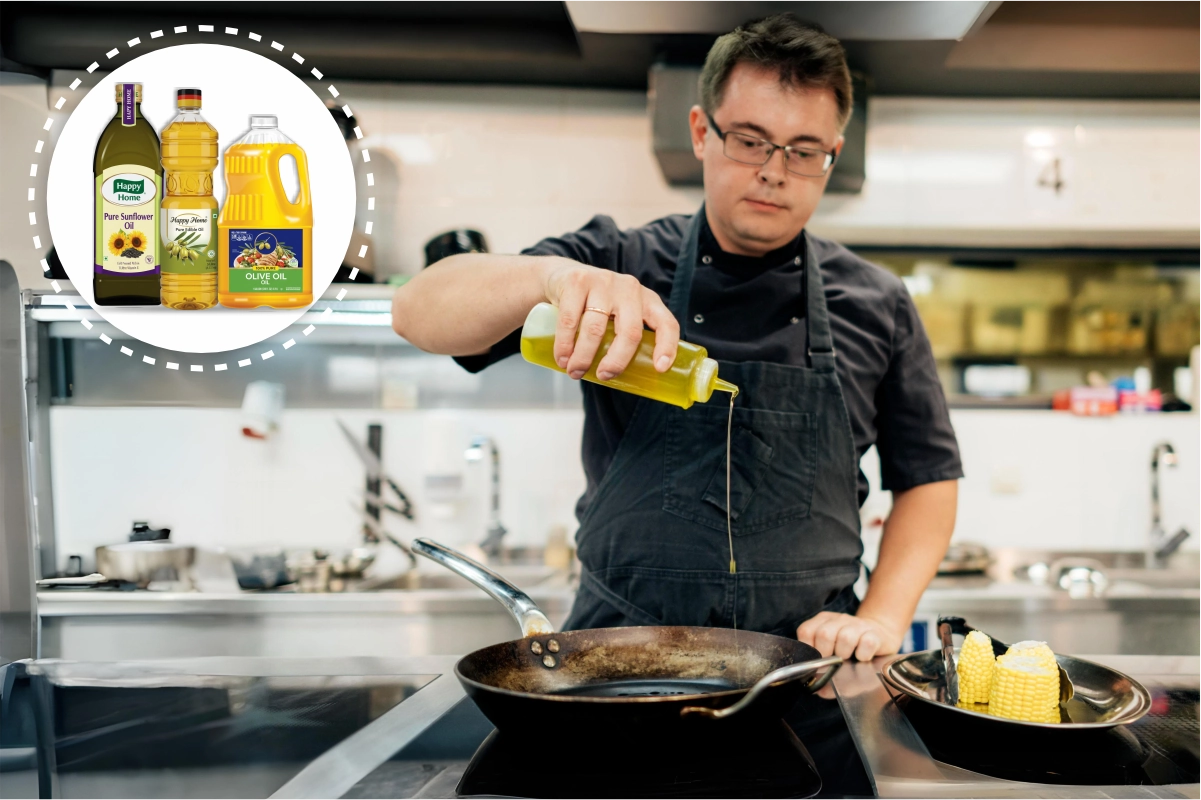
What truly sets oil apart from water-based cooking methods is its ability to reach and sustain much higher temperatures. This property enables faster cooking, improved browning, and the crisp finishes that many dishes rely on for appeal and taste. At the same time, edible oil is not limited to high-heat applications. It plays an equally important role in cold and low-heat preparations—such as salad dressings, marinades, dips, and finishing drizzles—where it carries flavours, enhances mouthfeel, and brings balance to a dish without the need for cooking at all.
Nutritional Value of Edible Oils and the Importance of Informed Oil Selection
From a nutritional standpoint, edible oil is far more than a calorie source. It supplies essential fatty acids that the body cannot produce on its own and delivers fat-soluble vitamins such as A, D, E, and K, which are vital for vision, immunity, bone health, and cellular protection. However, oils differ significantly in their fatty acid composition—ranging from saturated and monounsaturated to polyunsaturated fats—and these differences directly influence their health impact. The way an oil is extracted and processed further affects its nutritional value, stability, and suitability for different cooking methods.
In today’s health-conscious environment, choosing the right edible oil has become an informed decision rather than a habitual one. Consumers now consider smoke points, processing methods, refinement levels, and nutritional profiles before selecting an oil for their kitchen. This growing awareness has elevated edible oil from a basic pantry staple to a strategic component of everyday wellness, culinary performance, and long-term health—making thoughtful selection more important than ever before.
Which Types of Cooking Oils Are Available in the Market?
The modern market offers a wide range of types of cooking oils, classified primarily by their source and the methods used to process them. This diversity is not accidental—it reflects decades of agricultural innovation, food science research, and shifting consumer expectations. Oils now come from seeds, nuts, fruits, and even animal sources, each bringing its own flavour profile, nutritional composition, and functional behaviour in the kitchen. As a result, the choice of oil directly influences not only taste, but also texture, aroma, and cooking efficiency.
Processing methods further define how an oil performs and how it supports health goals. Cold-pressed and minimally processed oils retain much of their natural character, including aroma, antioxidants, and micronutrients, making them attractive to consumers who prioritize purity and nutritional integrity. In contrast, refined oils undergo advanced processing to improve stability, raise smoke points, and extend shelf life. These oils suit high-heat cooking and large-scale food production, where consistency and performance matter as much as flavour. Understanding these distinctions allows both home cooks and commercial buyers to match the oil to the task rather than forcing a one-size-fits-all solution.
Health considerations have become a central factor in this decision-making process. Different oils contain varying proportions of saturated, monounsaturated, and polyunsaturated fats, along with omega-3 and omega-6 fatty acids that play distinct roles in the body. Selecting the right oil can support heart health, manage inflammation, and align with specific dietary needs. At the same time, choosing the wrong oil for a particular cooking method can degrade nutrients and negatively affect both flavour and wellness.
Importance of Cooking Oil Packaging in the Edible Oil Businesses
For businesses, especially in food manufacturing, hospitality, and retail, understanding oil categories is equally critical. The right choice affects cost control, product consistency, shelf life, and consumer perception. In a market where customers increasingly read labels and ask informed questions, the ability to select and communicate the right cooking oil has become a competitive advantage. Today, knowledge of cooking oil types is no longer optional—it is an essential part of delivering quality, performance, and trust in every meal and product.
Edible oil production involves two critical stages: extraction and refinement, and together they define the quality, stability, and commercial value of the final product. Every oil—whether positioned as a premium cold-pressed offering or a high-volume household staple—begins with the careful removal of oil from seeds, nuts, or fruits. Producers select extraction methods based on the raw material’s oil content, desired nutritional profile, and intended market positioning. This first stage sets the foundation for everything that follows, influencing flavour, aroma, yield, and purity.
Edible Oil Processing: Extraction Methods and Refinement for Quality and Stability
Extraction techniques range from traditional mechanical pressing to advanced industrial processes. Cold pressing and expeller pressing appeal to brands focused on minimal processing and natural characteristics, preserving antioxidants and native flavours. On the other end of the spectrum, large-scale producers often rely on solvent extraction to achieve maximum yield and economic efficiency. While this method delivers consistency and volume, it requires downstream refinement to meet food-grade standards. Choosing the right extraction approach is a strategic decision that balances quality expectations, production costs, and supply chain demands.
Refinement represents the second and equally important stage in edible oil production. During refinement, manufacturers remove impurities such as free fatty acids, waxes, pigments, odours, and residual solvents to improve appearance, stability, and shelf life. This process enhances an oil’s resistance to oxidation and increases its smoke point, making it suitable for high-temperature cooking and long-term storage. However, refinement can also reduce naturally occurring nutrients, which is why some producers deliberately limit refining steps for speciality or health-focused oils.
For edible oil packaging companies and producers, these processing decisions directly shape packaging requirements and market strategy. Refined oils often move through high-speed automated lines into PET bottles, tins, or bulk containers designed for efficiency and distribution at scale. Minimally processed oils demand protective packaging—such as dark glass bottles or airtight containers—to preserve freshness and nutritional value. In a competitive global market, aligning extraction and refinement methods with the right packaging solution is not just a technical choice—it is a business decision that defines product integrity, brand credibility, and long-term success.
Refined Oils
Refined oils undergo extensive processing to remove impurities, odours, colour, and free fatty acids.
Manufacturers design refined oils for stability, neutral taste, longer shelf life, and higher smoke points. These oils work well for deep frying, large-scale food production, and repeated heating.
Common refined oils include sunflower oil, soybean oil, palm oil, rice bran oil, and blended vegetable oil.
Cold-Pressed Oil / Kachi Ghani Oil
Cold-pressed oil is an advanced processing method extracted without high heat or harsh chemicals. This gentle process preserves natural aroma, antioxidants, and nutrients. These oils often retain stronger flavours and are preferred by health-conscious consumers, similar to kachi ghani oil.
Popular cold-pressed oil options include mustard oil, groundnut oil, coconut oil, sesame oil, and olive oil. Although these oils have lower smoke points, they excel in low to medium-heat cooking and raw applications.
Various Processing Types Used by Edible Oil Companies
Edible oil production involves two critical stages: extraction and refinement. Different edible oil packaging companies and producers adopt processing methods based on oilseed type, production scale, and target market.
Oil Extraction Methods
Chemical Solvent Extraction: Large-scale producers often use solvents like hexane to extract maximum oil from seeds. This method offers high yield and efficiency.
Mechanical Pressing: Expeller presses mechanically extract oil, while cold pressing limits heat generation to preserve nutrients.
Decanter Centrifuge: This method separates oil using centrifugal force and is commonly used for olive oil and speciality oils.
Refinement Processes
Refinement improves oil stability, appearance, and shelf life. It may include degumming, neutralization, bleaching, deodorizing, dewaxing, filtration, and antioxidant addition. While refined oils gain consistency, unrefined oils retain more natural characteristics.
Importance of Edible Oil Packaging
Edible oil packaging protects one of the most sensitive food products from light, air, moisture, and contamination. Without proper packaging of cooking oil, oils oxidize quickly, lose nutritional value, and develop off-flavours.

High-quality food oil packaging ensures:
- Extended shelf life
- Retention of flavor and nutrients
- Hygiene and food safety
- Regulatory compliance
- Consumer trust and brand value
Packaging also plays a marketing role. Clear labelling communicates oil type, processing method, certifications, and usage tips—helping buyers make informed decisions.
Types of Edible Oil Packaging and Their Importance
Different markets demand different edible oil containers, each serving a specific purpose in the edible oil packaging business.
Metal Tins
Metal tins offer excellent protection from light and physical damage. They suit bulk storage, exports, and industrial use.
Glass Bottles
Glass bottles are premium, non-reactive, and ideal for cold-pressed oil and speciality oils. They enhance product perception and purity.
Plastic Bottles (PET)
Edible oil PET bottles dominate retail markets due to their lightweight design, cost efficiency, and durability. They remain the backbone of modern vegetable oil packaging.
Plastic Containers and Jars
Plastic jars and containers, especially 5-litre packs, serve households, hotels, and commercial kitchens.
Jerry Cans
Jerry cans support bulk distribution and industrial buyers in the cooking oil packaging business.
Pouches
Pouches offer economical and eco-friendly edible oil packaging options with reduced material usage and lower transportation costs.
Each packaging format balances protection, convenience, cost, and sustainability.
Various Oils for Cooking Use
The wide range of edible oils available today reflects the diversity of modern cooking, health priorities, and cultural food traditions. Oils such as avocado, olive, almond, macadamia, and walnut oils are valued for their nutrient density, heart-healthy fats, and delicate flavours, making them ideal for low-heat cooking, dressings, and finishing applications. At the same time, versatile everyday oils like canola, sunflower, soybean, rice bran, corn, cottonseed, and safflower oils deliver neutral taste, heat stability, and consistent performance, which makes them well-suited for frying, baking, and large-scale food production. Each oil brings a distinct balance of smoke point, flavour, and nutritional value that influences how it performs in the kitchen.
Consumers today have access to all types of oils for cooking, each offering unique properties.
Several oils also stand out for their bold character and specialised culinary roles. Sesame and mustard oils contribute strong aromas and deep flavours that define many regional cuisines, while peanut oil excels in high-temperature cooking due to its excellent heat resistance. Coconut oil, butter oil, and cocoa butter offer unique fat structures that enhance texture, richness, and shelf stability in both cooking and confectionery applications. Palm oil and palm kernel oil play a crucial role in food manufacturing, bakery, and confectionery segments thanks to their stability, long shelf life, and functional fat properties. Beyond everyday cooking, speciality oils such as apricot, Brazil nut, cashew, grape seed, hemp, basil, and hazelnut oils extend their value into wellness, cosmetic, and functional food applications. These oils provide essential fatty acids, antioxidants, and aromatic compounds that support heart health, skin and hair care, and overall nutrition when used appropriately.
Harikrushna Machines Pvt. Ltd.’s Edible Oil Packaging Line is the one-stop solution.
The Edible Oil Packaging Line is a fully integrated, high-performance packaging solution engineered to meet the demands of modern cooking oil packaging operations. Designed to handle container sizes ranging from 10 ml to 20 liters, this line delivers an impressive output of up to 120 products per minute, making it ideal for both retail and bulk edible oil packaging. The system efficiently processes all types of food oil, refined oil, and cooking oil, ensuring consistent fill accuracy, hygiene, and production efficiency across a wide range of applications.
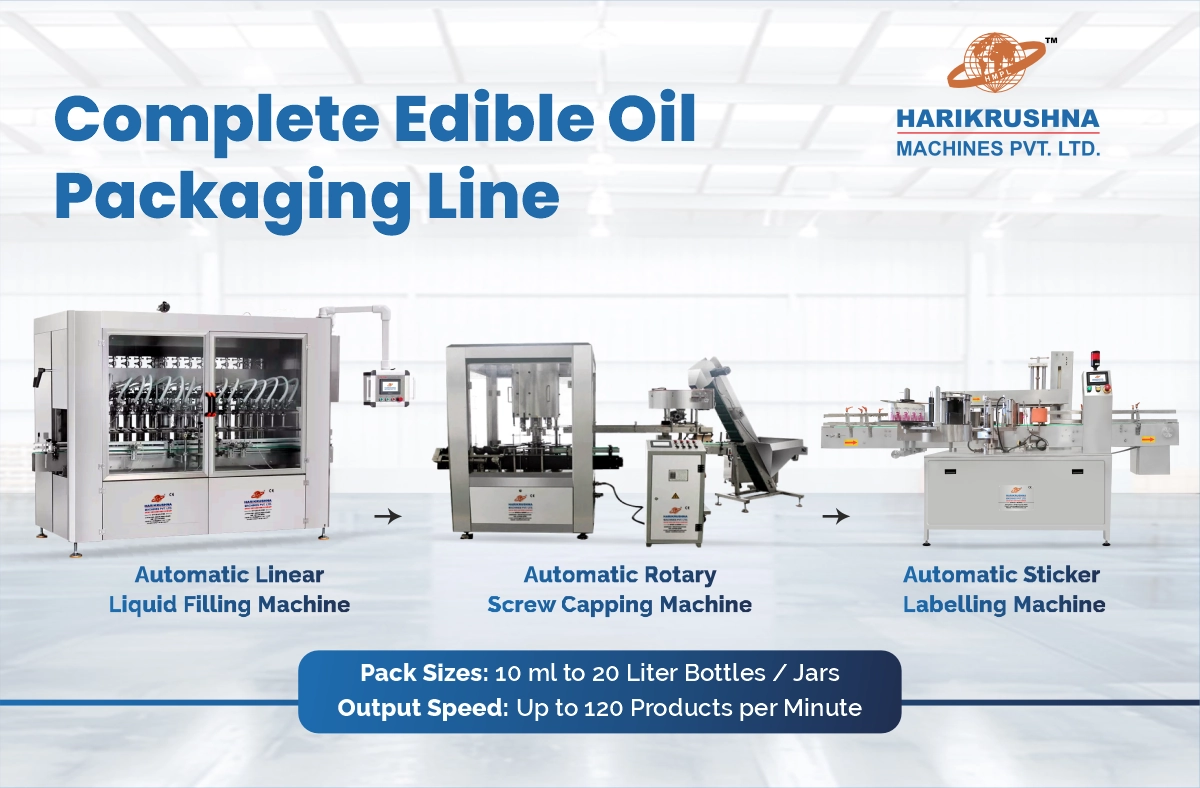
Edible Oil Filling Machine:
At the core of this solution is the Edible Oil Filling Machine/ Automatic Linear Liquid Filling Machine, developed by Harikrushna Machines Pvt. Ltd.. This machine combines precision engineering with advanced automation to deliver reliable, repeatable filling results. The integrated line includes a linear filling machine, a capping machine, and a sticker labelling machine, all synchronized for smooth product flow. Its robust design and intelligent controls ensure minimal downtime, reduced product wastage, and dependable performance in high-volume edible oil packaging environments.
Automatic Rotary Screw Capping Machine:
The Automatic Rotary Screw Capping Machine ensures secure and uniform sealing across a wide variety of bottles and jars. Built on a sturdy main frame, the machine features an adjustable product transmission belt, an in-feed screw, and a star plate for accurate bottle positioning under the sealing heads. A vibratory bowl efficiently orients and feeds caps through a delivery chute, while height adjustment mechanisms allow quick changeover between different container sizes. Controlled by a sophisticated electrical panel with motors, sensors, and AC drives, the machine delivers stable, high-speed operation. An optional acrylic safety enclosure further enhances operator protection without compromising accessibility.
Automatic Sticker Labelling Machine:
Completing the line is the Automatic Sticker Labelling Machine, designed for precise labelling of both round and flat edible oil bottles. The system incorporates a strong structural frame, adjustable product guides, and a smooth transmission belt to ensure flawless container movement. A separator unit maintains consistent spacing between bottles, while the label dispenser and wrapping units apply labels accurately and securely. Managed by a PLC-based control system with an intuitive HMI, the machine allows easy monitoring and quick parameter adjustments. Optional batch coding or printing units can be added to meet traceability and compliance requirements.
Together, this complete edible oil filling line delivers a seamless, end-to-end packaging solution that supports speed, accuracy, and scalability. By combining advanced filling, capping, and labelling technologies into one synchronized system, Harikrushna Machines enables edible oil manufacturers to achieve consistent product quality, enhanced operational efficiency, and long-term reliability in competitive packaging environments.
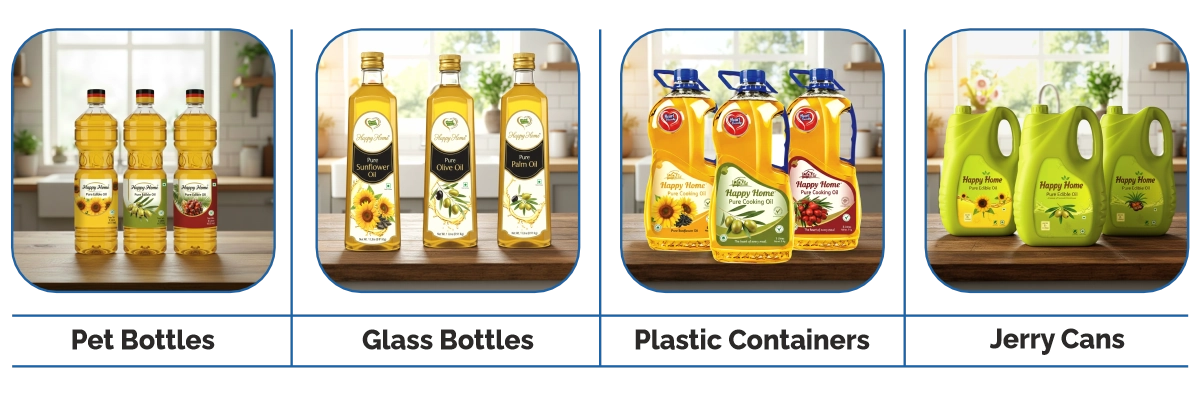
HMPL offers complete solutions for:
- PET bottles
- Glass bottles
- Plastic containers and jars
- Jerry cans
From small-scale startups to large edible oil packaging companies, HMPL supports accuracy, hygiene, scalability, and automation.
Sustainability in Edible Oil Packaging
Sustainability has become essential in modern cooking oil packaging. Brands now focus on:
- Recyclable PET bottles
- Lightweight edible oil containers
- Reduced plastic consumption
- Energy-efficient oil packaging machines
Eco-friendly edible oil packaging not only reduces environmental impact but also appeals to conscious consumers and global markets.
The Future of Cooking Oil Packing
Cooking oil packaging has evolved into a sophisticated blend of food science, engineering, and sustainability. From understanding edible oil and types of cooking oils to selecting the right edible oil packaging bottle and machinery, every step influences quality, safety, and market success.
With advanced oil packaging machines, innovative packaging formats, and eco-friendly solutions, the future of the cooking oil packaging business looks strong, efficient, and sustainable. As consumer demand grows, reliable packaging of cooking oil will continue to define excellence in the edible oil industry.